The Pilot-to-Scale Scorecard
Pilot-to-scale: the 10-question scorecard

10 questions that predict whether a pilot will survive
Happy Tuesday. This week is a practical tool for prioritization: a scorecard that helps leaders and builders decide what’s ready to scale—and what needs redesign first.
The idea in 30 seconds
Most pilots die from predictable causes: fuzzy ownership, weak workflow fit, and “metrics theater.” Scaling requires an operating model, not enthusiasm.
The framework
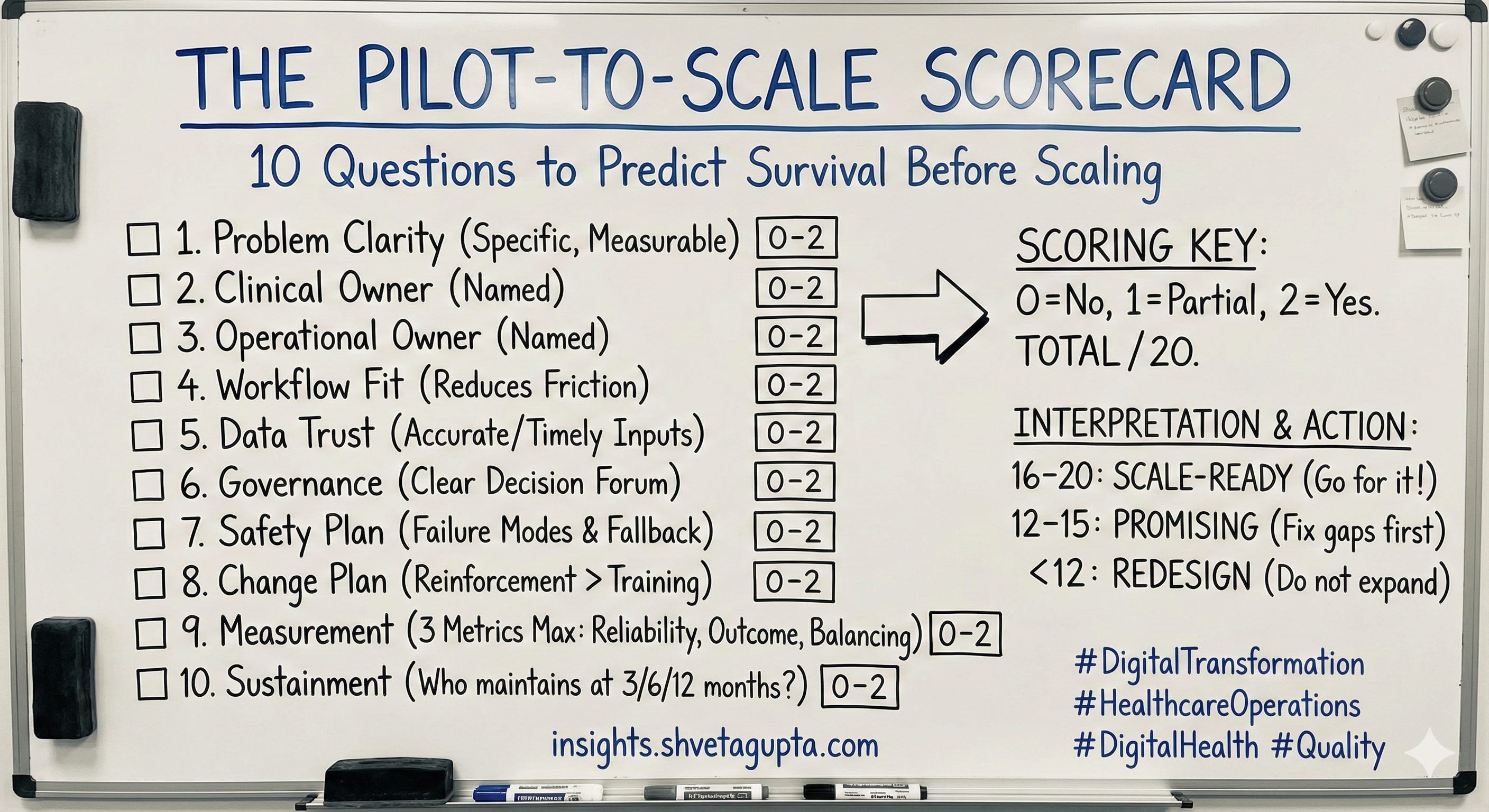
Score each item 0–2 (0=no, 1=partial, 2=yes). Total /20.
Problem clarity (specific, measurable)
Clinical owner (named)
Operational owner (named)
Workflow fit (reduces friction)
Data trust (inputs accurate/timely)
Governance (clear decision forum)
Safety plan (failure modes + fallback)
Change plan (reinforcement > training)
Measurement (3 metrics max: reliability + outcome + balancing)
Sustainment (who maintains at 3/6/12 months)
Interpretation:
16–20: scale-ready
12–15: promising, fix gaps first
<12: redesign before expanding
A quick example
A pilot looked great in one unit, then collapsed when the champion rotated off service. The scorecard would have flagged missing sustainment ownership and weak reinforcement loops.
How to measure it
Leading indicator: scorecard total before go-live
Early signal: week-2 reliability metric
Scale signal: month-2 sustainment (adoption + reliability holding steady)
One action for this week
Use this scorecard on your next pilot proposal. If anything is “0,” treat it as a design requirement—not a footnote.