The 3 Trust Tests for Digital Health Adoption
Why good tools fail in the real world

Happy Tuesday. This week’s note focuses on adoption. If you’re seeing low uptake, the root cause is often not motivation—it’s trust.
The idea in 30 seconds
Adoption is usually a trust problem: clinical, workflow, and system trust. If any one is weak, adoption erodes.
The framework
Three trust tests:
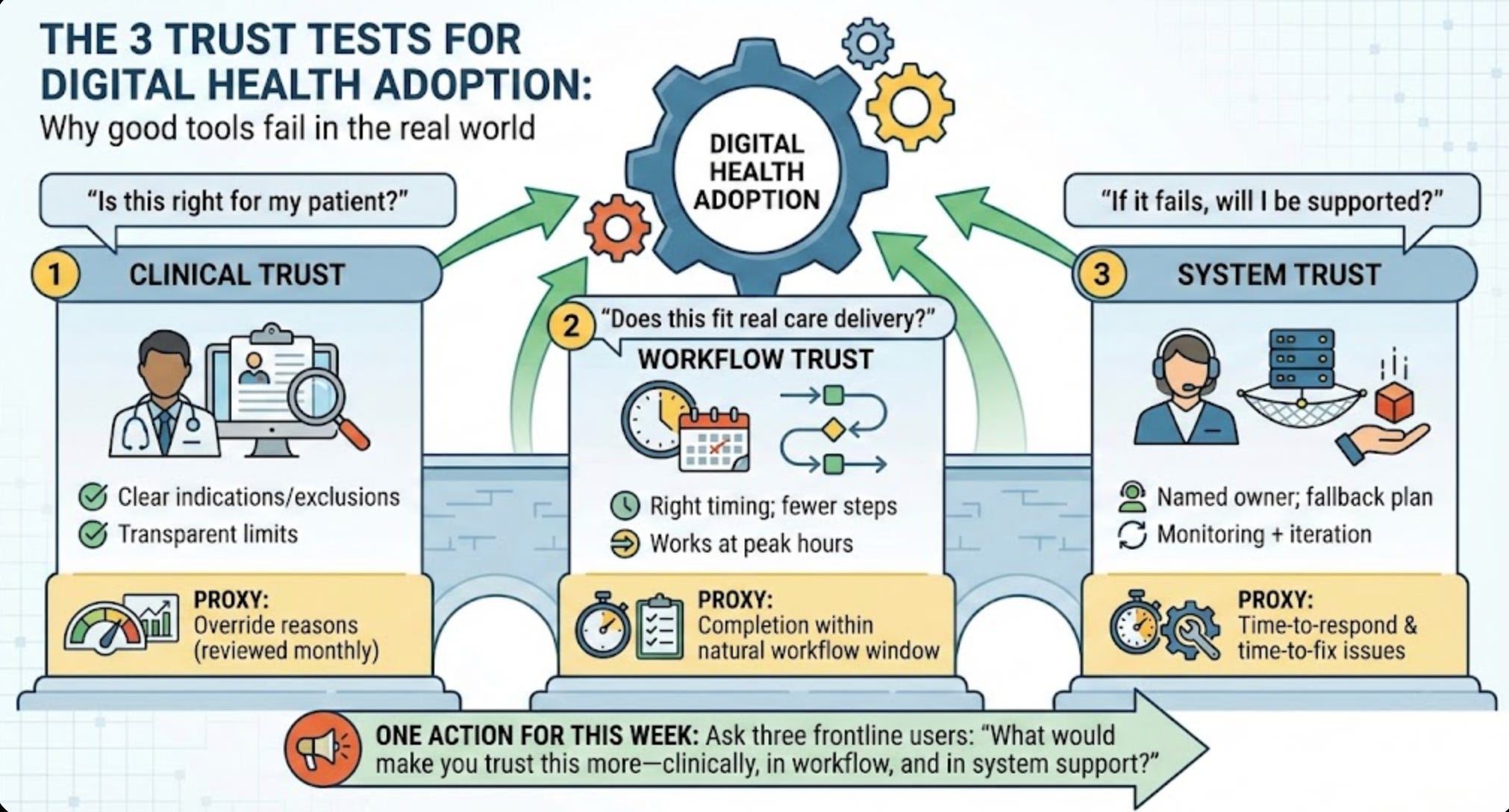
Clinical trust: “Is this right for my patient?” Clear indications/exclusions; transparent limits.
Workflow trust: “Does this fit real care delivery?” Right timing; fewer steps; works at peak hours.
System trust: “If it fails, will I be supported?” Named owner; fallback plan; monitoring + iteration.
A quick example
A tool had strong evidence, but the alert appeared after the decision was already made. Clinical trust was high; workflow trust was low. Adoption improved when timing and next-step clarity improved.
How to measure it
Clinical trust proxy: override reasons (reviewed monthly)
Workflow trust proxy: completion within the natural workflow window
System trust proxy: time-to-respond and time-to-fix issues
One action for this week
Ask three frontline users: “What would make you trust this more—clinically, in workflow, and in system support?”
Subscribe/share: