Resistance is Data
Resistance is data: diagnose pushback in 5 buckets

A practical way to diagnose pushback (and respond well)
Happy Thursday. This week’s note focuses on the people side of transformation—how to interpret resistance and turn it into better design. You’ll get a simple diagnostic, a quick example, and one action to try this week.
The idea in 30 seconds
Resistance usually isn’t “people being difficult.” It’s often a signal that the change threatens time, identity, autonomy, or safety—or the workflow simply doesn’t work.
The framework
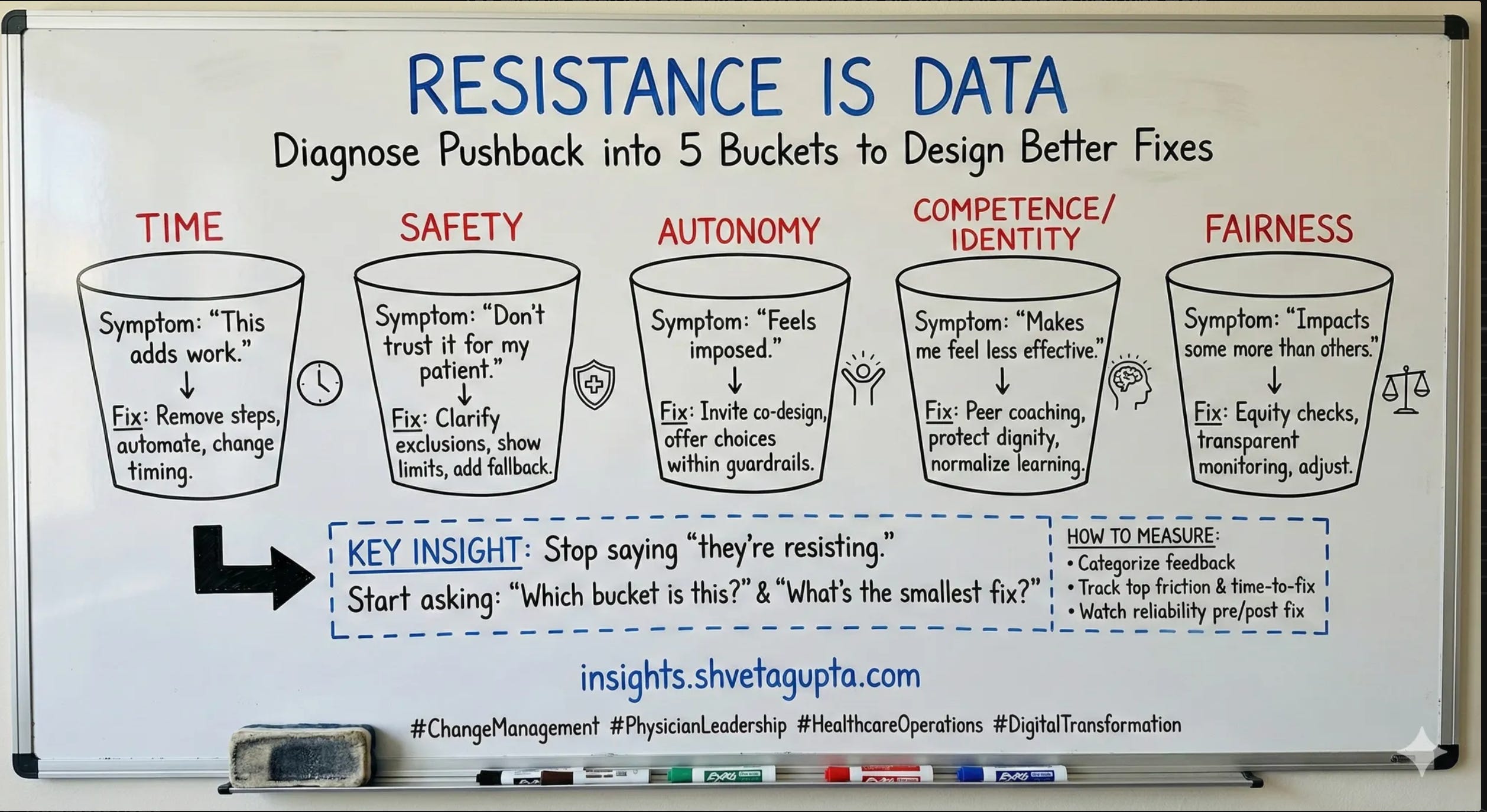
When you hear pushback, diagnose which bucket it’s in:
Time: “This adds work.” Fix: remove steps, change timing, automate, reduce duplication.
Safety: “I don’t trust it for my patient.” Fix: clarify indications/exclusions, show limitations, and add escalation/fallback.
Autonomy: “This feels imposed.” Fix: invite co-design, offer choices within guardrails, explain decision rights.
Competence/identity: “This makes me feel less effective.” Fix: peer coaching, supportive rollout, normalize learning curve, protect dignity.
Fairness: “This will impact some teams/patients more.” Fix: equity/burden checks, transparent monitoring, and adjust implementation.
A quick example
A tool was labeled “extra clicks,” but the real issue was autonomy: frontline clinicians felt they had no voice. A short co-design session changed wording, timing, and ownership—and adoption improved quickly.
How to measure it
Categorize feedback into the 5 buckets (simple tally)
Track the top 2 friction items and time-to-fix
Watch reliability before/after fixes (did the needle move?)
One action for this week
In your next meeting, replace “they’re resisting” with:
“Which bucket is this feedback in—and what’s the smallest fix we can test?”
Subscribe/share:

Reply with topics you’d like me to cover.