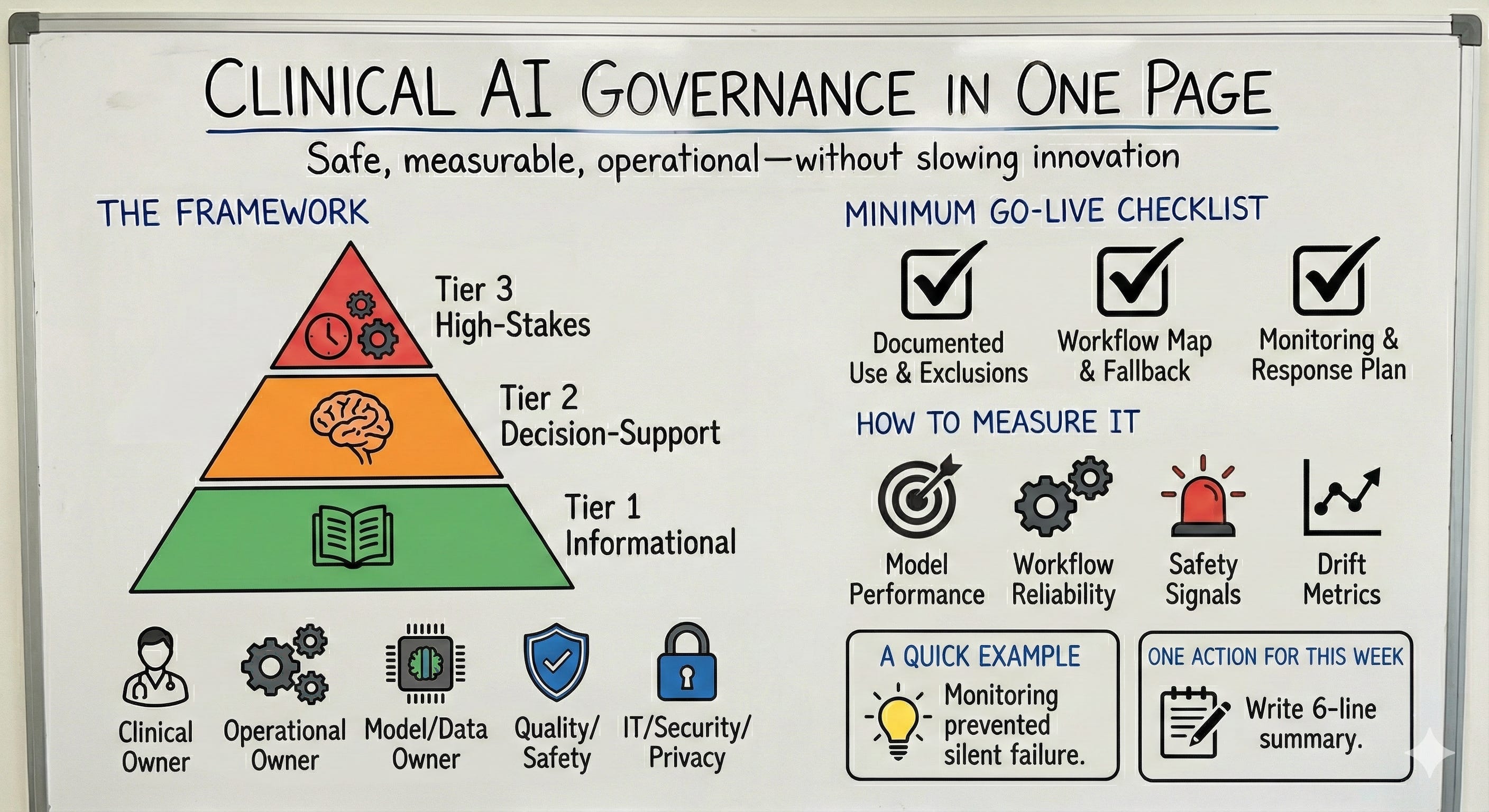
Clinical AI Governance in One Page

Safe, measurable, operational—without slowing innovation
Happy Tuesday. This week’s note offers a one-page governance model that makes clinical AI safer and easier to operationalize—clear decision rights, risk tiers, and monitoring.
The idea in 30 seconds
AI doesn’t need more committees. It needs clarity: who owns it, how risk is tiered, what gets monitored, and what happens when it fails.
The framework
Risk tiering (simple):
Tier 1 (Informational): no direct clinical action
Tier 2 (Decision-support): influences actions
Tier 3 (High-stakes): time-sensitive / high harm potential/automation
Owners (explicit):
Clinical owner (intent + safe use)
Operational owner (workflow + adoption)
Model/data owner (performance + drift)
Quality/safety (incident review)
IT/security/privacy (access + audit)
Minimum go-live checklist:
Intended use + exclusions documented
Workflow map + fallback plan
Monitoring plan (metrics + cadence + reviewer)
Incident response (escalation + “pause/kill switch” criteria)
A quick example
A model “worked” until the underlying workflow changed and performance drifted. A basic monitoring cadence + clear ownership prevented silent failure and restored trust quickly.
How to measure it
Choose what matches your use case:
Model performance (calibration / PPV / sensitivity)
Workflow reliability (% intended action occurs)
Safety signals (overrides, incidents, near-misses)
Drift metrics (performance over time; subgroup checks when applicable)
One action for this week
For any AI initiative, write a 6-line summary: purpose, population, exclusions, tier, primary metric, and monitoring cadence.